It always happens like this.
A storm rolls in. Power flickers. Someone tries to call the operations team… and the call drops. Another person sends a message—“Are we evacuating?”—and the text just sits there spinning.
No signal. No response. No idea what’s happening across the building.
Meanwhile, people are looking around waiting for instructions.
This is the moment when organizations realize something uncomfortable: modern communication systems are amazing—until they aren’t.
And when they fail, one of the simplest tools in the room suddenly becomes the most valuable.
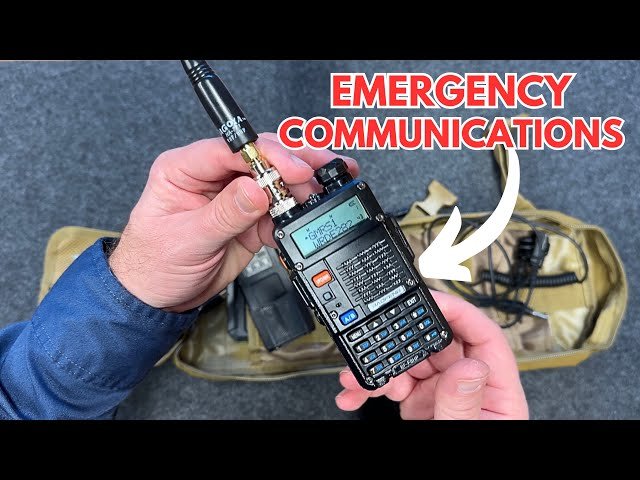
Enter the walkie talkie.
Not glamorous. Not flashy. But in emergency communication planning? Surprisingly essential.
Why Emergency Plans Can’t Depend on Just One System
Let’s start with a simple rule of preparedness.
If your emergency communication plan depends on exactly one technology… it’s not really a plan.
Phones rely on towers.
Messaging apps rely on internet access.
Internal systems rely on electricity and servers.
Remove any of those pieces during a crisis and communication can collapse quickly.
And crises have a bad habit of breaking multiple things at once.
That’s why serious emergency planning focuses on redundancy. Multiple channels. Backup systems. Communication methods that continue working when others fail.
This is exactly where radio communication earns its spot.
The Beauty of Simple Radio Communication
A walkie talkie works differently from most modern communication tools.
Phones route messages through networks, towers, and providers. Radios skip all that. They transmit signals directly between devices.
Push a button. Speak. Message sent.
No dialing. No waiting for someone to answer. No apps asking for updates.
It’s simple by design—and during emergencies, simplicity is powerful.
Because when people are stressed, moving quickly, and trying to coordinate responses, complicated technology becomes friction.
Push-to-talk? Anyone can figure that out in seconds.
Instant Group Communication (No Phone Tag Required)
Imagine trying to coordinate an evacuation using phone calls.
You call one supervisor. Then another. Then someone else. Each conversation repeats the same instructions.
Slow. Inefficient. Easy for details to get lost.
Now imagine the same situation with radios.
“All staff, move to the north exit immediately.”
Message delivered.
Everyone hears it at the same time.
That ability to broadcast instructions instantly is one of the biggest reasons emergency response teams rely on radio systems. Whether it’s security personnel, facility managers, or event coordinators, group communication keeps everyone aligned during fast-moving situations.
And alignment matters.
When Cellular Networks Collapse
Here’s something many people don’t realize until disaster strikes: cellular networks don’t always fail because they break.
Sometimes they fail because they’re overwhelmed.
During emergencies, thousands of people attempt to make calls or send messages simultaneously. Networks become congested. Calls drop. Messages delay.
Meanwhile, teams trying to coordinate safety procedures are left waiting for connections.
A walkie talkie avoids that problem entirely.
Radio communication operates independently from traditional mobile networks, meaning it continues functioning even when cellular systems are overloaded or unavailable.
For organizations that operate in large facilities, campuses, construction sites, or event venues, that reliability is invaluable.
Teams exploring communication tools for emergency preparedness often evaluate modern walkie talkie systems that combine traditional push-to-talk functionality with extended coverage and durable equipment. Organizations looking to strengthen their response plans can learn more about walkie talkie communication solutions and how they support emergency coordination.
Because when communication matters most, reliability beats convenience every time.
Field Teams Already Know This
Ask anyone who works in operations, security, or large-scale logistics about communication tools.
You’ll hear a familiar answer.
Radios.
Construction crews use them to coordinate equipment. Event teams use them to manage crowds. Security personnel rely on them for rapid response. Manufacturing facilities use them during safety incidents or power outages.
These industries didn’t adopt radios out of nostalgia.
They adopted them because they work.
Especially when things get unpredictable.
Simplicity Wins in High-Stress Situations
Emergencies introduce chaos.
People move quickly. Information changes rapidly. Stress levels rise.
Communication tools used in these environments must be intuitive. No training manuals. No complicated instructions.
Just one button.
Push. Speak. Listen.
That simplicity allows teams to coordinate even when conditions are far from ideal.
And when you think about it, that’s exactly what emergency communication planning is about: preparing for the moments when nothing else goes according to plan.
The Old Tool That Still Saves the Day
In a world filled with smartphones, apps, and cloud platforms, the walkie talkie might seem like a relic.
But emergency planning has a funny way of revealing which tools actually matter.
When networks fail, when systems overload, when coordination becomes urgent…
The simplest technology often proves the most dependable.
Push the button.
Say what needs to be said.
And suddenly, everyone is back on the same page.