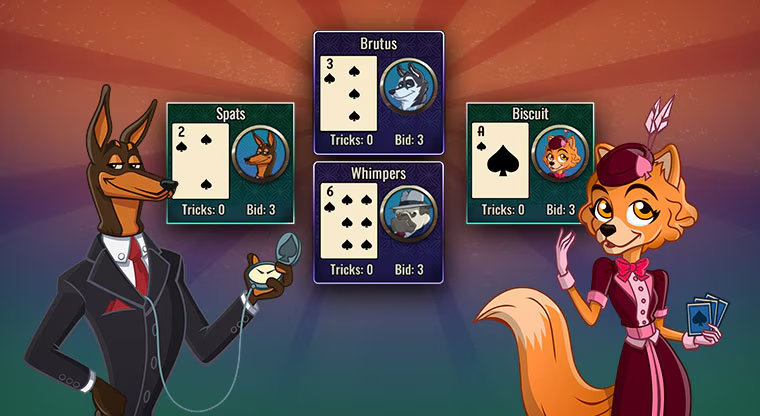
When people want to unwind with others without the pressure of constant small talk, many now play Spades online as a simple, structured way to connect. The game gives conversation a built-in rhythm. Players share a goal, react to the same hand, and stay engaged without needing to fill every pause. That makes online Spades a surprisingly effective option for low-stress socialization.
Why can online Spades feel easier than many other kinds of social interaction?
Online Spades can feel easier than many social activities because it gives people a shared task, clear rules, and natural turn-taking. That structure lowers conversational pressure, reduces awkward silences, and allows connection to build through teamwork and light competition rather than through nonstop personal disclosure.
A lot of social fatigue comes from unstructured interaction. In a group chat or video call, people often feel pressure to be quick, funny, or consistently interesting. A card game changes that. In Spades, attention is directed toward the hand, the bid, and the partnership. Conversation becomes optional support rather than the whole event.
That shift matters because structure can make social time feel safer. People do not have to invent topics from scratch. They can respond to the game itself. A missed bid, a smart lead, or a surprising comeback gives the group something to react to in real time.
Online play also helps because it offers a softer level of proximity. People can connect from home, on their own schedule, without the logistics of travel or the intensity of face-to-face group settings. For friends who want to stay in touch but feel drained by formal catch-ups, Spades can be a lighter format.
This kind of connection is not trivial. The CDC says about 1 in 3 adults in the United States report feeling lonely, and about 1 in 4 report lacking social and emotional support. Social connection, by contrast, can improve how people manage stress, anxiety, and depression.
How does the structure of Spades support low-stress socialization?
The structure of Spades supports low-stress socialization because it balances focus and interaction. Players are engaged in a shared activity, but the game also creates pauses, patterns, and role clarity. That combination helps people participate socially without feeling overexposed, overstimulated, or responsible for carrying the entire exchange.
Spades works well socially because it is interactive without being chaotic. Enough is happening to keep people interested, but not so much that the experience becomes noisy or overwhelming. The game gives each player a role, a turn, and a purpose.
Partnership play helps even more. You are not just sitting in the same room or on the same call. You are working with someone. That creates a quick sense of alliance, even when the interaction is casual. Shared goals often make connections feel more natural than direct social performance.
The game also offers a useful emotional distance. Players can joke, comment, or stay mostly quiet without seeming disengaged. Because the cards provide the central focus, people can participate at different comfort levels. Someone who is socially tired can still be present and involved.
That matters in a world where social strain has real consequences. The U.S. Surgeon General’s advisory on social connection says loneliness and social isolation are associated with higher risks for anxiety, depression, heart disease, and stroke, and that lacking social connection can increase the risk for premature death as much as smoking up to 15 cigarettes a day.
What makes online Spades a good fit for people who want a calmer connection?
Online Spades is a good fit for calmer connections because it gives people predictable interaction, moderate mental engagement, and a clear beginning and end. It is social without being intrusive, competitive without being constant, and absorbing without demanding the emotional energy of more intense group settings.
Not every social activity is restful. Some involve too much noise, too much self-presentation, or too much pressure to stay “on.” Spades offer a different rhythm. It is active, but it does not require a high-performance version of yourself.
The pace helps. Players have time to think. They do not need to answer instantly or dominate the conversation. The game also naturally contains interaction. A hand ends. A round resets. That sense of structure can make the experience feel manageable, especially for people who find open-ended social time draining.
There is also something useful about the game’s focus. People are not staring at a blank chat window, trying to create a connection from nothing. They are responding to visible situations. That tends to reduce friction. Shared attention often makes shared presence easier.
This links to a broader productivity and well-being principle. The American Psychological Association notes that shifting between tasks can reduce productivity by as much as 40%. Activities that keep attention within one clear frame can therefore feel mentally cleaner than fragmented online interaction. Spades does that by giving players one shared problem at a time.
How should people play Spades online if the goal is low-stress socialization?
To make online Spades low-stress, players should keep the environment light, choose familiar partners when possible, and treat the game as a shared activity rather than a test of skill. Calm connection works best when expectations are clear, pacing is relaxed, and the emphasis stays on enjoyment over performance.
The first rule is simple: do not overbuild the experience. A relaxed online Spades session does not need a long setup or intense competition. It works best when the stakes stay low and the social tone stays easy.
A few habits help:
Pick the right group. Familiar players usually make the experience smoother because less energy goes into reading personalities and more goes into enjoying the game.
Keep sessions short. One or two games can be enough to create a connection without turning the activity into another obligation.
Use the game as a bridge, not a burden. Some groups will talk a lot. Others will mostly focus on play. Both are fine.
Avoid turning every hand into a critique. Friendly strategy talk can be fun, but constant correction raises the pressure.
This approach matters because social connections often grow through small, repeatable contact rather than one big event. The CDC specifically notes that even small acts of connection can help build supportive, meaningful relationships.
Why does playing cards online still count as a meaningful social connection?
Playing cards online still counts as a meaningful social connection because a connection is not defined only by physical proximity. Shared attention, repeated interaction, and mutual engagement all strengthen social bonds. When people return regularly to the same game and the same group, familiarity and trust can develop in real ways.
There is sometimes a tendency to dismiss online interaction as less real than an in-person connection. That view is too narrow. Meaningful connection depends on consistency, mutual attention, and a sense of being with other people in a shared experience. Online Spades can provide all three.
A card game may seem modest, but modesty is part of the value. Not every connection needs to be deep, confessional, or highly emotional to matter. Sometimes what people need most is a dependable, low-pressure way to spend time together.
That is what makes Spades useful. It offers structure for the mind and space for the relationship. It creates a reason to show up, a rhythm for interaction, and a shared experience that does not ask too much from anyone at once.
For people who want social contact without social overload, that is a strong case for the game. To play Spades online is not just a way to pass the time. Done well, it is a practical way to stay connected while keeping the experience calm, manageable, and enjoyable.